


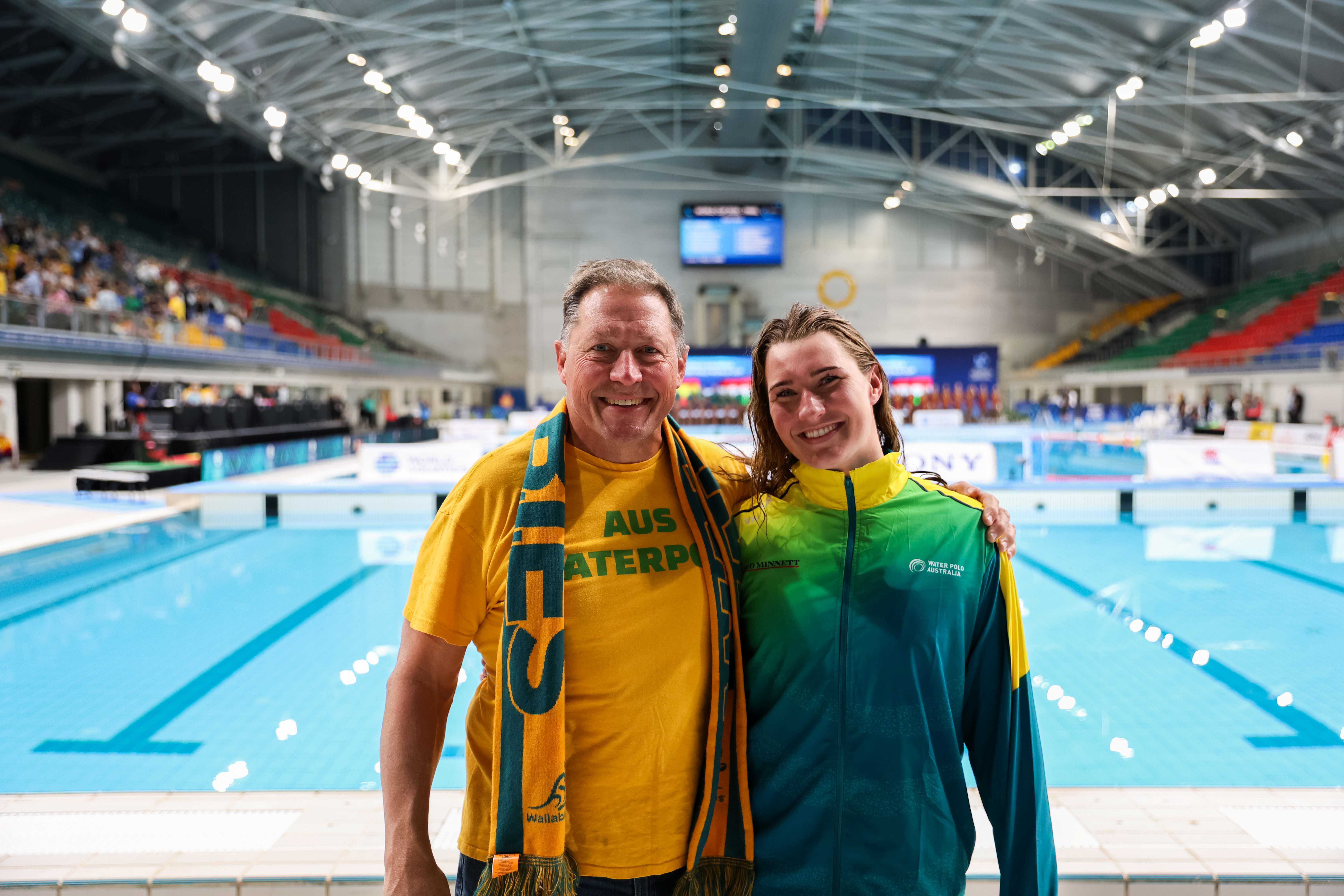
A Wallabies captain turned Minerva Board Director and an Olympian at the peak of her career sit either side of the same question: what does an athlete carry with them when the game is over?
In July, the Australian Stingers took bronze at the World Aquatics Water Polo World Cup Finals in Sydney, and Tilly Kearns was named the most valuable female player of the tournament. Watching from the stands was her father, Phil Kearns AM, former Wallabies captain, Minerva Network Board Director and Ambassador.
They came to women's sport from opposite directions. What they share is a conviction about what a career in sport actually teaches, and a frustration that the world outside the pool does not yet know how to value it.
"It was the first time we really got to show Australia who we are".
For Tilly, the medal was not the headline.
"What I will remember most from the World Cup this year is that it was the first time we really got to show Australia who we are in front of a home crowd," she says. "Of course I am proud of the bronze medal, and of the MVP award, but I am even prouder of the way our team came together and the way we represented ourselves for Australia."
What has stayed with her since are the messages from young girls watching on.
"They say how close we seem as a team and how much fun it looks like we are having. I love that, because it is genuinely who we are. We mess around, make funny videos, laugh, cry and do not take ourselves too seriously off pool deck. But when it is time to compete we switch on and can perform against the best teams in the world. I think that is something really special."
Her father saw the same thing from the other side of the glass.
"We are always proud of our daughter, and we are always proud of the people we are surrounded by," Phil says. "Some of the girls in that team I have known a long time. I am really proud of the way they have lifted themselves over the last six years, from a team that was not so great at the Olympics in Tokyo to a team that outperformed in Paris."
"What was also great about the tournament in Sydney was the number of people who came along, and their enthusiasm. Faces painted, bodies painted green and gold, people chanting. It was fantastic to see, particularly the number of kids who were there. That is really building the profile of water polo."
Phil's route to the Minerva Network board began with an observation about his own career.
"I have known for a long time how powerful the rugby network is," he says. "I am eternally grateful to rugby for lots of reasons, but that network in business is really important. It helped pave my way as a young bloke going into the business world. So many of the people who helped me, I had met through rugby."
Nothing about it was formal. It simply existed.
"There was no formal network like it on the women's side, and I just thought how wonderful that would be. Many female business leaders I spoke to looked on that network a little jealously."
He is careful about where he places the blame for the gap.
"There was a perception from the female side that men were not particularly eager to help. I think that is a massive fallacy. Many people in business are just as willing to help female athletes with what they want to achieve after their career as they are to help men. The one major difference is that the male athletes feel they can ask."
That, he argues, is precisely the work a network like Minerva does. "Just having the courage to ask the question is really important. A network that is a little more formal gives women the comfort to ask for that assistance in whatever career they are aiming to pursue."
Having a daughter in elite sport sharpened it. "Absolutely it was a factor. Not only her, but her teammates. I have seen a lot of these girls since they were fifteen or sixteen, in various teams and rep teams, and you have watched them grow up. I am more than willing to give them a hand in their post-sport career, or even during it. It is a privilege. They have done so much for the country."
Phil's central point is a financial one, and then immediately something larger.
"The huge majority of athletes have to have a job. They cannot live for the rest of their lives on what they have made out of their sport. Hockey players, water polo players, the athletes who have just been to the Commonwealth Games. They do not earn a lot and they need assistance outside of that."
"But what they need beyond the financial side is confidence. Working with a Minerva mentor can help bring that out. Understanding the skills you have earned and learnt through sport is so important in business, and a lot of athletes do not give that enough credit."
He runs through the translation himself. Managing teammates is managing colleagues. Working through injury, a run of losses, or a team that is not performing is problem solving under pressure. Leadership, good and bad, has been modelled in front of them for years.
"Those are skills the average person does not have. For an athlete to go into a business, or to start one, with those attributes already, is incredibly valuable. There is no reason they cannot bring them into the business world."
Tilly, still mid-career, describes the same lessons from the inside. Moving between Sydney, the United States, the Stingers and professional water polo in Europe taught her something that has nothing to do with the sport.
"It has taught me how important people and culture are. No matter where I have lived or what team I have joined, I have realised how much of a difference it makes when you create a safe, supportive environment where people feel comfortable being themselves." "Moving between different countries and systems has also taught me to be my own constant. I think it is important not to rely on other people to make an experience worthwhile. I always try to respect the culture I am stepping into while bringing a bit of my own personality. I have learned so much about different people and different ways of doing things, but probably even more about myself."
What keeps her in, and what she would change
"My teammates, without a doubt," Tilly says. "I love competing, I love the adrenaline, and I love chasing big goals. But what helps the jump into a cold pool at 6am is that I do it with my best friends."
The trade-offs are real. "Elite sport means you rarely own your own schedule. There are so many opportunities, holidays and events I have had to turn down because the answer is always, sorry, I cannot, I have waterpolo. It is a privilege to play professionally, but it definitely comes with sacrifices."
Her one structural wish is a domestic one. "I would love to see a stronger league in Australia. At the moment, if you want to play at the highest level, you almost always have to move overseas. It would be amazing if Australia became a destination for international players instead."
Phil, characteristically, agrees and extends it. "There is no doubt this nation produces the best sporting events in the world. We know how to do sport."
Life outside the pool
The two haven't talked much lately about what comes after. They did not need to.
"Growing up, my parents were always very intentional about reminding me that I needed a life outside of water polo," Tilly says. "They encouraged me to commit to my education, nurture friendships and explore interests beyond the sport, and I never really questioned that philosophy. It has definitely shaped how I have approached my career, and why I am so passionate about creating opportunities beyond the pool while I am still playing."
It is the same philosophy her father is now trying to build at scale.
Asked what he wants for Minerva, Phil answers in two horizons.The short term is unglamorous and urgent. "Our short-term goal is to obtain funding so Minerva can be self-funded and continue to grow. It is really difficult to get funding for Minerva, which it should not be. But it is."
The long term is the point of the whole exercise. "The proof in the pudding is seeing female athletes in positions of influence, in business or politics or sport. Confident women moving into those roles."
And for anyone weighing up whether to back it, his case is short.
"We are not making the most of our resources. If we only have a network that involves men, then we are missing out on half of it. If we can add our female athlete cohort to that, we are making the most of our human resources and making the country a better place."
Tilly's advice to the eighteen-year-old about to make the leap she made carries the same instinct.
"Think holistically and make the decisions for yourself. When you are a talented eighteen-year-old, everyone has an opinion about what is best for you, and decisions can become clouded by coaches, parents, teachers and clubs all genuinely wanting to help. Take their advice on board, but trust your own instincts and do not make decisions just to keep other people happy. You will be the one who has to live the reality. So listen, learn, and then back yourself."
Pathways at Minerva
The Minerva Network supports more than 1,100 high-performance female athletes across 86 sports. Career transition pathways include:
- One-to-one mentoring, matching athletes with a networkof more than 490 volunteer businesswomen across sectors
- Careers Connect, our job board on the Minerva Portal, connecting athletes with roles and work experience through partner and mentor organisations
- Sports governance pathways, including the AICD Company Directors Course Fundamentals and the Deloitte Board Readiness Program
- Leadership and professional development programs delivered through our state chapters
- Minerva Amplify, creating media, speaking and profile-building opportunities
- Access to a national network of corporate partners,sporting bodies and senior businesswomen
Minerva athletes in the Stingers World Cup squad included Bronte Halligan, Abby Andrews, Gabi Palm, Alice Williams, Genevieve Longman and Tilly Kearns.


